
I like this cartoon shared by Oilyboyd on YouTube. It is a very visual message. Are we ready to give up our oil dependency?
Oilyboyd — November 17, 2007
"We've already burned through almost half the world's supply of oil. How will we ride out the slide down the other side of Hubbert's Curve?"
14 May 2010

13 May 2010
What Can We Do to Reduce Our Oil Dependency?
Tony Brucato explains in sign language about how the oil spill in Gulf of Mexico negatively impacts our ecosystem and suggests the four ways that we can do to reduce our oil dependency.
After watching the video, please share your ideas and suggestions of different ways in reducing our oil dependency for cleaner planet and better future.
Namaste!
After watching the video, please share your ideas and suggestions of different ways in reducing our oil dependency for cleaner planet and better future.
Namaste!
09 May 2010
Composting is so Easy, Deaf 1st Graders Show you How!
Jarrod and Estelina, Deaf six-year-old 1st graders at the California school for the Deaf talk about composting in American Sig Language.
Many thanks, @yatesburns for permission to post on EcoDeaf!
08 May 2010
Cutting your Hair? Reuse it for the Gulf Oil Spill!
Watch this fascinating 3-minute educational video about how our hair collects oil quickly and can help lessen the impact of oil spills like the recent one in the Gulf of Mexico. Makes sense... you shampoo because hair collects oil! That means it can collect petroleum oil spills too.
Make sure when you have your hair cut, to combine your hair with others at the salon and have them mail hair to Matter Of Trust non-profit organization.
01 May 2010
Going Green with MyPyramid
Sandy Graham shares a fact sheet made by the United States Department of Agriculture's MyPyramid website.

The contents of that fact sheet are below. For direct access to the fact sheet go to www.mypyramid.gov/downloads/TenTips/GoingGreenTipsheet.pdf or http://goinggreenwithmypyramid.blogspot.com/2010/04/going-green-with-mypyramid.html
The contents of that fact sheet are below. For direct access to the fact sheet go to www.mypyramid.gov/downloads/TenTips/GoingGreenTipsheet.pdf or http://goinggreenwithmypyramid.blogspot.com/2010/04/going-green-with-mypyramid.html
Did it ever occur to you that your daily food choices can impact the environment? Food has a lot to do with the environment—probably much more than you’d think. From farm to table, there are many points where green decisions can be made.
1. Buy directly from a farmer
Check out your local farmer’s market or join a CSA (Community Supported Agriculture). Look for local sources of fruits, vegetables, meat, poultry, cheese, or eggs. They may have traveled fewer miles and contain less packaging, thereby saving energy.
2. Buy in bulk
Shop in stores that sell foods in bulk bins to reduce solid waste and resource use. Food co-ops often offer many grains, flours, beans, nuts, dried fruit, soup mixes, and ready-to-eat cereals in bulk. Buying in bulk may be cheaper, too.
3. Reduce food package waste
Buy larger sizes. Omit single serve containers and juice boxes from your grocery list. Buy milk and yogurt in the largest container you will use. Recycle: take your own shopping bags to the store!
4. Look for the USDA Organic seal
When shopping, look for the USDA Organic seal. It assures you that the agricultural products marketed as organic meet strict standards. Organic crops are raised without using most conventional pesticides or petroleum-based fertilizer. Animals raised on an organic farm must be fed organic feed and given access to the outdoors. They are given no antibiotics or growth hormones.
5. Eat seasonally
Plan your meals around the vegetables and fruits that are in season in your growing area. Seasonal fruits and vegetables can be less expensive, too
6. Vary your choices in meat and beans
Sometimes use nuts or beans, such as kidney, pinto, or garbanzo beans, to vary the protein in your entrée. Less energy is used to produce them, compared to the energy used to produce meat or poultry.
7. Start a vegetable garden
When you grow your own food, you control the use of pesticides and omit the need for transportation or packaging. If you have a small space, try herbs on your windowsill or other vegetables in pots.
8. Think natural
Buy foods in their natural state or minimally processed, such as rolled oats instead of instant oatmeal, or fresh chicken instead of chicken nuggets. This reduces the fossil fuels needed for processing. It can lower your calories, too.
9. Drink tap water
Eliminate individual water bottles from your grocery list. Buy a reusable water bottle and fill it with tap water. Water from your tap is free. The processing, packaging, transportation, and storage of bottled water uses more fossil fuel and bottle disposal adds to household waste.
10. Cook at home
26 April 2010
What is the Most Eco way to be Buried?
I've always thought my grandparents were very eco for their time. When they passed away, they donated their bodies to teaching hospitals. The hospital picked up the bodies, had student doctors practice on them for a period of time, then cremated the bodies and sent us ashes along with an autopsy report. I thought this was the coolest way to say good-bye...!
but then, thanks to Dan Brubaker on Facebook, I came across his link - there is a much more eco-way to die! Giving your body back earth... without the use of fire (cremation) or wood (caskets) or tombstones (cement), etc. How?
I must warn you - the concept and pictures may be very graphic to some people. If you are sensitive to death and dead bodies, please, please do not click on these links.
I wonder if this can legally be done in the USA? Do you have other eco-options for burial? Share away.
TED - Earth Day Talks

From TEDxIslay:
It’s Earth Day, so what better time to spotlight some of the smartest, most compelling thinking in sustainability from the past few years, and what better place for these ideas to manifest themselves than the TED stage? Today, we’re posting our five favorite sustainability-related TED talks of the past five years — from eye-opening revelations to ideological landmarks.
1) Michael Pollan Gives a Plant's-Eye View
3) Janine Benyus: Biomimicry in Action
4) Sylvia Earle's TED Prize Wish to Protect Our Oceans
5) Chris Jordan Pictures Some Shocking Stats
23 April 2010
Gallaudet Goes Carbon-Neutral for Earth Day
by Rhea Yablon Kennedy
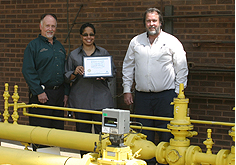
Facilities administrators display a "C-Neutral Certificate" from energy supplier Hess declaring that Gallaudet went 100 percent carbon neutral on April 22 in honor of Earth Day. Pictured (from left) are William Banks, facilities project engineer; Meloyde Batten-Mickens, executive director of Facilities; and Stephen Kalmus, chief engineer in Utilities Services. Photo by Rhea Yablon Kennedy
Director of Sustainability for Green Gallaudet Rachel Benedict and student Michael Pachuilo work together to make an emission-free smoothie during a bake sale. The March 1 to 3 sale was one of the ways the student organization has connected with the community to urge greener practices and spread an eco-conscious message. Photo by José Garcia.
As part of an ongoing effort to make University operations more eco-friendly, the campus went carbon-neutral on April 22 in honor of Earth Day.
"The effect is as if we shut the boilers down for the day," said Stephen Kalmus, chief engineer in Utilities Services. Kalmus arranged to rely on natural gas for as much of the day's energy needs as possible, and he purchased carbon offsets for the remainder of the energy.
In recent years, the Facilities staff, led by Dr. Meloyde Batten-Mickens, executive director of the Facilities Department, worked in multiple ways to make Gallaudet more sustainable every day. Mickens credits her team, as well as the students, the Environmental Stewardship Committee, and the environmental intern positions in Administration and Finance, for making this happen. "It's like a handshake," said Mickens. "It's a community effort."
It was members of the growing three-year-old organization, Green Gallaudet, who first reached out a hand to bring about a day of energy savings in 2009. On March 28, Kendall Green went dark in honor of the organization WWF's Earth Hour. The effort called on both Facilities and individuals to turn off lights on that Saturday evening.
Making Kendall Green
This is all part of a raft of initiatives that have increased Gallaudet's annual carbon savings from about 35,000 to more than 38,600 tons from 2008 to 2009, and continue to lighten the University's impact on the environment.
Gallaudet has had some initiatives in place for years. The recycling program has collected discarded paper and bottles for processing, while the shuttle service reduces Gallaudet's carbon footprint by making Metro and commuter trains a viable option for student and employee commutes.
Recently, Facilities has converted to using virtually all organic products for grounds maintenance. It further reduced chemical usage with the new incarnation of Hotchkiss Field. The field, used for football, soccer, and other activities, is made with recycled rubber and synthetic materials. Because there is no soil or grass to maintain, the field also greatly reduces water usage. The Sorenson Language and Communication Center, which opened in 2007, attained LEED certification, as will all subsequent new buildings on campus.
In 2007, Gallaudet transitioned to single-stream recycling, commingling trash and recyclables and then sending them to an off-campus facility to be separated. Paper towels used in the bathrooms are 100 percent recycled material, while hand soap and cleaning products are Green Seal certified. Even the ice melting crystals used to clear walkways after the winter's major snows were eco-friendly.
In 2008, the Facilities Department began yearly evaluations through the Go-Green Project, using the company Sightlines to monitor and benchmark Gallaudet's carbon footprint. The project looks at all aspects of the University's environmental practices, from electricity usage on campus to the distance that each employee travels to get to work. Sightlines provides both a snapshot of Kendall Green's impact and trending in its results. For utilities usage, Gallaudet also performed an Industrial Grade Energy Performance Review with Johnson Controls, Inc.
Mickens and Kalmus expect the savings to continue to climb. The very next report should show improvement, thanks to an increased amount of energy bought with Renewable Energy Certificates (from seven to 10 percent over the past year). In addition, Facilities, Green Gallaudet, and Bon Appetit Management Company, which oversees food service, plan to establish a composting system that keeps food scraps out of the waste bins.
Rachel Benedict, sustainability director for the student organization Green Gallaudet, says her organization has worked closely with Facilities to push Gallaudet toward a greener future. Other groups seek to go green, too, including the Student Body Government, which has pledged to use only biodegradable food service items for its campus events.
The flavor of sustainability

Facilities administrators display a "C-Neutral Certificate" from energy supplier Hess declaring that Gallaudet went 100 percent carbon neutral on April 22 in honor of Earth Day. Pictured (from left) are William Banks, facilities project engineer; Meloyde Batten-Mickens, executive director of Facilities; and Stephen Kalmus, chief engineer in Utilities Services. Photo by Rhea Yablon Kennedy
Green Gallaudet also found a willing partner in Davina Kwong, general manager for Bon Appetit. Disposing of leftovers is just one of the ways that Gallaudet's cafeterias are doing their part. Kwong emphasizes not only waste reduction, but also the other side of the production process. "Yes it's true that recycling and compostables are important, but it's even more important to think about where our food comes from," she explains.
Kwong and Chef Manager Jay Keller focus on buying regional and seasonal produce and sustainably-produced meat, dairy, and fish. In the Hanson Plaza cafeteria, students eat with reusable plates and flatware; in the Jordan Student Academic Center's grab-and-go Marketplace, Keller purchases low-carbon packaging. Hot and cold beverage cups and napkins contain a minimum of 10 percent and 35 percent post consumer fiber (PCF), respectively, while the cup sleeves are 100 percent PCF. All cutlery is presented individually as opposed to in sets, reducing waste, and instead of individual condiment packets, diners take a dollop of ketchup or a cup of mustard from dispensers. As the composting program moves into place, Keller is set to phase in as much compostible packaging as possible. "Some believe that being 'green' is the cool new thing," said Kwong. "For us, it's at the root of what we do on a day-to-day basis."
Benedict and her Green Gallaudet team are reaching out to show what individuals can do to improve sustainability. Green Gallaudet has combined outreach with fundraising efforts by selling low-impact snacks, including fruit smoothies blended by a bicycle. The group also created a video explaining ways to reduce waste in the cafeteria.
Next steps toward a greener future
Director of Sustainability for Green Gallaudet Rachel Benedict and student Michael Pachuilo work together to make an emission-free smoothie during a bake sale. The March 1 to 3 sale was one of the ways the student organization has connected with the community to urge greener practices and spread an eco-conscious message. Photo by José Garcia.
Among Green Gallaudet's long-term goals are for the University to sign on to the American College and University Presidents' Climate Commitment. Kendall Green does not yet have the systems set up to satisfy all of the stipulations in the agreement, but Mickens says they have already made progress and hopes to see a presidential signature soon.
The Environmental Stewardship Committee, comprised of student, faculty, and staff representatives, will play a role in working toward that goal. Mickens appreciates the students' urging to make things happen. "I love it that the students were ahead of us," said Mickens. "That's one of the things that helped us come together and pushed us toward more sustainability priorities."
--Rhea Yablon Kennedy
Facilities administrators display a "C-Neutral Certificate" from energy supplier Hess declaring that Gallaudet went 100 percent carbon neutral on April 22 in honor of Earth Day. Pictured (from left) are William Banks, facilities project engineer; Meloyde Batten-Mickens, executive director of Facilities; and Stephen Kalmus, chief engineer in Utilities Services. Photo by Rhea Yablon Kennedy
Director of Sustainability for Green Gallaudet Rachel Benedict and student Michael Pachuilo work together to make an emission-free smoothie during a bake sale. The March 1 to 3 sale was one of the ways the student organization has connected with the community to urge greener practices and spread an eco-conscious message. Photo by José Garcia.
As part of an ongoing effort to make University operations more eco-friendly, the campus went carbon-neutral on April 22 in honor of Earth Day.
"The effect is as if we shut the boilers down for the day," said Stephen Kalmus, chief engineer in Utilities Services. Kalmus arranged to rely on natural gas for as much of the day's energy needs as possible, and he purchased carbon offsets for the remainder of the energy.
In recent years, the Facilities staff, led by Dr. Meloyde Batten-Mickens, executive director of the Facilities Department, worked in multiple ways to make Gallaudet more sustainable every day. Mickens credits her team, as well as the students, the Environmental Stewardship Committee, and the environmental intern positions in Administration and Finance, for making this happen. "It's like a handshake," said Mickens. "It's a community effort."
It was members of the growing three-year-old organization, Green Gallaudet, who first reached out a hand to bring about a day of energy savings in 2009. On March 28, Kendall Green went dark in honor of the organization WWF's Earth Hour. The effort called on both Facilities and individuals to turn off lights on that Saturday evening.
Making Kendall Green
This is all part of a raft of initiatives that have increased Gallaudet's annual carbon savings from about 35,000 to more than 38,600 tons from 2008 to 2009, and continue to lighten the University's impact on the environment.
Gallaudet has had some initiatives in place for years. The recycling program has collected discarded paper and bottles for processing, while the shuttle service reduces Gallaudet's carbon footprint by making Metro and commuter trains a viable option for student and employee commutes.
Recently, Facilities has converted to using virtually all organic products for grounds maintenance. It further reduced chemical usage with the new incarnation of Hotchkiss Field. The field, used for football, soccer, and other activities, is made with recycled rubber and synthetic materials. Because there is no soil or grass to maintain, the field also greatly reduces water usage. The Sorenson Language and Communication Center, which opened in 2007, attained LEED certification, as will all subsequent new buildings on campus.
In 2007, Gallaudet transitioned to single-stream recycling, commingling trash and recyclables and then sending them to an off-campus facility to be separated. Paper towels used in the bathrooms are 100 percent recycled material, while hand soap and cleaning products are Green Seal certified. Even the ice melting crystals used to clear walkways after the winter's major snows were eco-friendly.
In 2008, the Facilities Department began yearly evaluations through the Go-Green Project, using the company Sightlines to monitor and benchmark Gallaudet's carbon footprint. The project looks at all aspects of the University's environmental practices, from electricity usage on campus to the distance that each employee travels to get to work. Sightlines provides both a snapshot of Kendall Green's impact and trending in its results. For utilities usage, Gallaudet also performed an Industrial Grade Energy Performance Review with Johnson Controls, Inc.
Mickens and Kalmus expect the savings to continue to climb. The very next report should show improvement, thanks to an increased amount of energy bought with Renewable Energy Certificates (from seven to 10 percent over the past year). In addition, Facilities, Green Gallaudet, and Bon Appetit Management Company, which oversees food service, plan to establish a composting system that keeps food scraps out of the waste bins.
Rachel Benedict, sustainability director for the student organization Green Gallaudet, says her organization has worked closely with Facilities to push Gallaudet toward a greener future. Other groups seek to go green, too, including the Student Body Government, which has pledged to use only biodegradable food service items for its campus events.
The flavor of sustainability

Facilities administrators display a "C-Neutral Certificate" from energy supplier Hess declaring that Gallaudet went 100 percent carbon neutral on April 22 in honor of Earth Day. Pictured (from left) are William Banks, facilities project engineer; Meloyde Batten-Mickens, executive director of Facilities; and Stephen Kalmus, chief engineer in Utilities Services. Photo by Rhea Yablon Kennedy
Green Gallaudet also found a willing partner in Davina Kwong, general manager for Bon Appetit. Disposing of leftovers is just one of the ways that Gallaudet's cafeterias are doing their part. Kwong emphasizes not only waste reduction, but also the other side of the production process. "Yes it's true that recycling and compostables are important, but it's even more important to think about where our food comes from," she explains.
Kwong and Chef Manager Jay Keller focus on buying regional and seasonal produce and sustainably-produced meat, dairy, and fish. In the Hanson Plaza cafeteria, students eat with reusable plates and flatware; in the Jordan Student Academic Center's grab-and-go Marketplace, Keller purchases low-carbon packaging. Hot and cold beverage cups and napkins contain a minimum of 10 percent and 35 percent post consumer fiber (PCF), respectively, while the cup sleeves are 100 percent PCF. All cutlery is presented individually as opposed to in sets, reducing waste, and instead of individual condiment packets, diners take a dollop of ketchup or a cup of mustard from dispensers. As the composting program moves into place, Keller is set to phase in as much compostible packaging as possible. "Some believe that being 'green' is the cool new thing," said Kwong. "For us, it's at the root of what we do on a day-to-day basis."
Benedict and her Green Gallaudet team are reaching out to show what individuals can do to improve sustainability. Green Gallaudet has combined outreach with fundraising efforts by selling low-impact snacks, including fruit smoothies blended by a bicycle. The group also created a video explaining ways to reduce waste in the cafeteria.
Next steps toward a greener future

Director of Sustainability for Green Gallaudet Rachel Benedict and student Michael Pachuilo work together to make an emission-free smoothie during a bake sale. The March 1 to 3 sale was one of the ways the student organization has connected with the community to urge greener practices and spread an eco-conscious message. Photo by José Garcia.
Among Green Gallaudet's long-term goals are for the University to sign on to the American College and University Presidents' Climate Commitment. Kendall Green does not yet have the systems set up to satisfy all of the stipulations in the agreement, but Mickens says they have already made progress and hopes to see a presidential signature soon.
The Environmental Stewardship Committee, comprised of student, faculty, and staff representatives, will play a role in working toward that goal. Mickens appreciates the students' urging to make things happen. "I love it that the students were ahead of us," said Mickens. "That's one of the things that helped us come together and pushed us toward more sustainability priorities."
--Rhea Yablon Kennedy
08 April 2010
GreenFestival this weekend in San Francisco!

What are you Bay Area eco-folks doing this weekend?
Why not go to the Green Festival? Here's the info:
San Francisco Green Festival, April 10 - 11, at the Concourse at 8th and Brannon!
Organics, renewable energy, sweatshop-free clothing, socially responsible investing, community networking, and more, all at the nation's largest green event.
Andrew Korfhage, our deaf-friendly GreenFestival volunteer, will be present at the ASL Table at the front of the hall to answer any questions you may have about Green Festival.
ASL/English interpreting available for parts of the Festival on a first-come/first-served basis. Please see Andrew at the ASL table at the front of the hall to schedule an interpreter. (Unfortunately, their interpreter resources are limited at present, and we do not currently have full coverage, with interpreters on-site for the entire duration of the Festival. They're still recruiting, especially for Saturday afternoon, so if you are an interpeter, or you know of one who would be interested to be available as a volunteer at the Festival, please contact Andrew at 202-321-1707.) Thanks and enjoy!
http://www.greenfestivals.org/san-francisco-spring/
Can't make it? Don't worry, there will be two more Green Festivals this spring, Chicago in May, and Seattle in June.
07 April 2010
Farmers, Mechanics and Babysitters
— Michael Pollan,
The Botany of Desire: A Plant's-Eye View of the World
Subscribe to:
Posts (Atom)

